

How Kwanda turned 17 countries into a content studio
100
Reels per day
Fund · Ongoing · 26 July 2026
Kwanda is a fund. Members contribute $5 a month, vote on what gets financed, and between them they back development projects across Africa and the Caribbean: boreholes, libraries, a robotics lab in Haiti, period poverty programmes in Kenya. When we started working with them, that meant projects running in 17 countries at once.
Members contributed because they could see the work, which meant the work had to be filmed. A fund built out of five-pound contributions could not pay for the camera crews its sector runs on, and flying them to 17 countries was never going to be possible. More filming would have broken the budget, and less would have broken the reason people joined.
So we built a studio that never sent a crew, because the footage was already being shot by the people doing the work.
Why the glossy film was the wrong answer anyway
Cost was the obvious constraint, but taste was the one that mattered more. Kwanda's members were young and online, they had joined through feeds, and Kwanda's own voice had always matched that. The polished development documentary is made for institutional funders in a boardroom once a year, so producing one well would have cost money Kwanda did not have, to sound like an organisation it was not.
We proposed the format their members were already watching instead: hand held, day in the life, shot on a phone.
The camera crew was already there
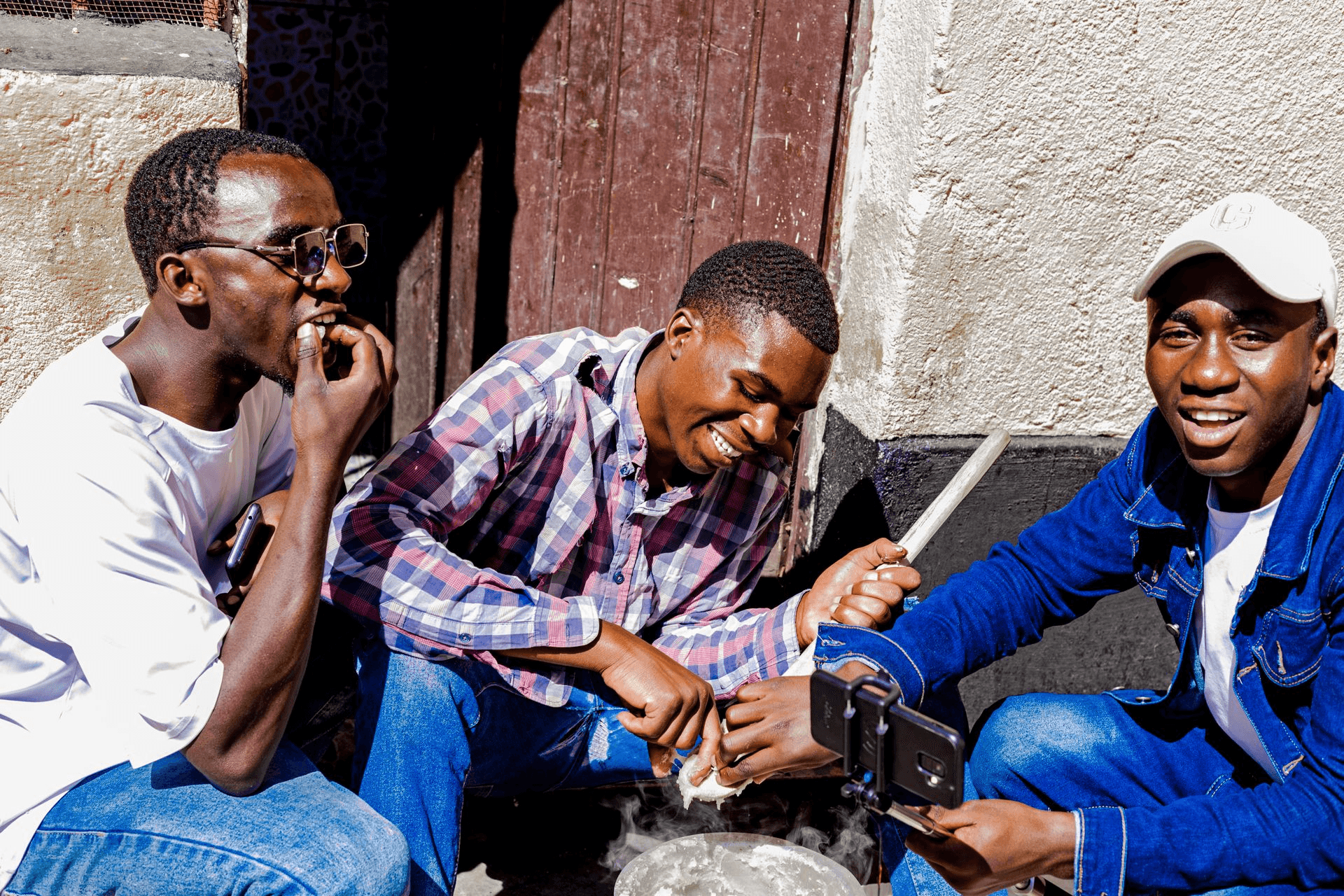
Every project Kwanda financed had people on the ground, whether partner organisations, local volunteers or staff who were at the borehole or in the classroom every week, and all of them carried phones. We designed the incentive around that, and Kwanda paid a stipend for every clip that met the standard.
It changed what content cost them. Rather than paying per project for a shoot, Kwanda paid per usable clip, and the pool of material grew each month instead of resetting to nothing. The same footage could be recut indefinitely.
Filming was never the difficult part. The difficulty was getting clips off people's phones reliably, sorting the usable from the unusable at volume, and turning a pile of unlabelled fragments into something worth watching.
One folder, and nothing else to learn
Each partner got a single shared Drive folder holding a sample film that showed what good footage looked like, a short written guide, and a dated folder for the current month. Dropping clips into it was the whole of what a partner had to do, which is why it got used by people with patchy connectivity and no appetite for another tool.
Behind that folder the system polled for new files and pulled them, keyed on the Drive file ID so nothing was processed twice. Nobody had to announce that footage had arrived.
Judging footage before a human saw it
Every clip was checked on orientation, length and resolution as it landed. We set those thresholds by probing Kwanda's existing archive rather than guessing, which turned out to matter, because most real uploads came in landscape, over-long and compressed by WhatsApp. Failures were logged with a reason and did not count towards the stipend, so the incentive and the standard pointed the same way.
Clips that passed had frames sampled out of them and sent to a vision model, which returned what was in the shot: subjects, action, setting, shot type, the number of people in frame, mood, and a score on framing, clarity and light. Partners tagged nothing. They filmed something and it arrived described.
Accepted clips were renamed to something searchable, filed by month, mirrored to cloud storage for rendering, and appended to a per-project index. Over time each project built a tagged library of its own footage, and that library rather than any individual reel was the asset.
The editor that watched its own footage
The agent built a contact sheet of every candidate clip and looked at it, so reels were ordered by what was on screen rather than by metadata. It picked an angle, whether the build, the payoff, the people or the numbers, and it tracked which angles and clips each project had already spent, so the fifth reel about a project was not a reshuffle of the first.
It then sequenced the clips into an arc, wrote the captions, and critiqued its own cut before going further, checking whether the opening hooked, whether the payoff landed, whether the reel was meaningfully different from earlier ones, and whether any clip was too weak to carry a beat. A cut that failed its own check went back for revision.
Scripts were read by a voice cloned from one of Kwanda's team, so the narration stayed consistently theirs without anyone booking a session. Reels were rendered with captions, an automatically generated music bed and a cover frame, ready to post. The loop ran unattended, taking footage in at one end and producing finished reels at the other.
What changed
The constraint moved from filming to recombination, and recombination was close to free. The same pool of footage produced up to 100 reels a day, and because the system tracked angles and clip use, those reels differed from each other rather than repeating.
Kwanda stopped buying content and started collecting it. Partners in 17 countries added to a library that arrived already tagged and ready to cut, and a story that would once have needed a flight and a shoot needed neither.